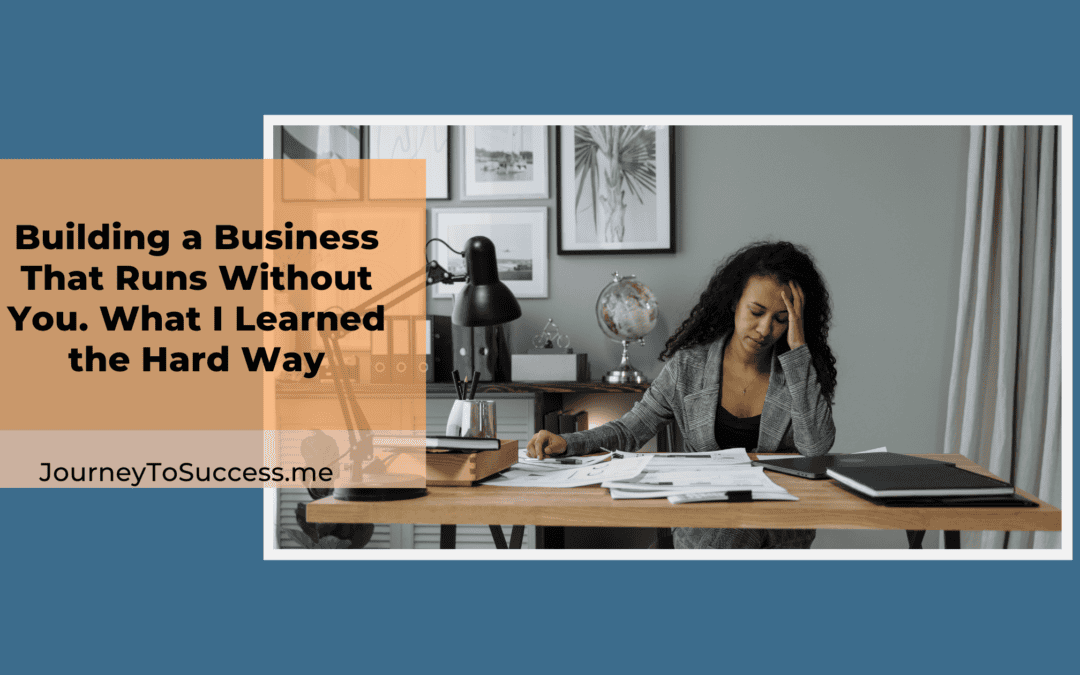
Building a business that runs without you isn’t about working harder or hiring faster. I learned that the hard way, over three years of building something that couldn’t survive a two-week break. Here’s what actually changed things, and why it matters more than almost anything else you’ll do as a founder.
Why Building a Business That Runs Without You Feels So Hard
For three years I built a business that couldn’t survive a two-week vacation.
It wasn’t because I didn’t work hard enough. It was because I built it wrong.
Every system ran through me. Every client relationship lived in my head. Every process existed because I was there to execute it, not because it was documented, delegated, or designed to outlast my involvement.
I told myself it was because I had high standards. That nobody else could do it the way I did. That the moment I stepped back, everything would fall apart. And for a long time, I was right.
However, I was right for the wrong reason. It wasn’t that my team wasn’t capable. It’s that I had designed a business that required my presence to function. I had built dependency into the architecture without ever realizing I was doing it.
This is the part most founders miss when they think about building a business that runs without you. Research from Gallup consistently shows that founder dependency, not team capability, is one of the leading drivers of business owner burnout and stalled growth. You can read more about that here.
The Moment I Realized I Wasn’t Building a Business That Runs Without You
The turning point came when I missed two weeks due to a health issue.
The business survived. Barely. But it survived.
And when I came back, I had a choice. I could keep building a business that needed me at the center, or I could rebuild it so it didn’t. Those were really the only two options, even though for years I had pretended there was some third path where I just worked a little harder and everything got easier on its own.
There isn’t a third path. There’s the business that depends on you, and there’s the business that doesn’t. And the difference between them isn’t effort. It’s design.
I chose the rebuild.
What Building a Business That Runs Without You Actually Requires
It took longer than I expected. Furthermore, it required me to let go of things I had convinced myself only I could handle.
It required me to trust people before I felt fully ready to. There were moments it felt slower and messier than just doing it myself, and every one of those moments tempted me back into the old pattern. That’s the part nobody tells you about building a business that runs without you. It feels worse before it feels better.
Here’s what the rebuild actually involved:
Documenting what lived in my head. The processes I ran on instinct had to become something someone else could follow. That meant writing them down, even the parts I thought were too obvious to document.
Defining ownership instead of just delegating tasks. There’s a difference between handing someone a task and giving them a domain. Real delegation means the other person owns the outcome, not just the to-do item.
Trusting before it felt comfortable. I had to let people make decisions I would have made differently. Some of those decisions were better than mine. Most were good enough. And the few that weren’t taught the team more than my corrections ever did.
Redefining my own role. I had to stop measuring my value by how involved I was and start measuring it by how well the business ran when I wasn’t
What’s on the Other Side of Building a Business That Runs Without You
On the other side of that rebuild was something I hadn’t felt in years.
Space.
Space to think. Space to lead. Space to actually work on the business instead of in it every single day. That space isn’t a luxury. It’s the thing that lets you see the bigger picture, make better decisions, and lead in a way that just isn’t possible when you’re buried in daily execution.
That experience is the foundation of everything I teach now. Because I learned the hard way that a business built around the founder’s constant presence isn’t a strength. It’s a ceiling.
The work of removing yourself from the center of everything isn’t stepping back from your business. It’s what finally lets it grow.
How to Start Building a Business That Runs Without You
If your business couldn’t survive you being gone for two weeks, that isn’t a sign you need to work harder. It’s a sign the design needs to change. Here’s where to start.
Notice where everything routes back to you. For one week, pay attention to every decision, question, and approval that lands on your desk. That map shows you exactly where the dependency lives.
Pick one area to fully hand off. Not partially. Fully. Choose something and give someone genuine ownership of it, including the authority to decide.
Resist the urge to take it back. The first time someone handles it differently than you would, that’s the test. Building a business that runs without you means letting good enough be good enough.
Measure your value differently. Start asking not how much you did today, but how well things ran without you needing to be in the middle of them.
This is exactly the kind of shift MindsetCoach.ai was built to support. As a guided reflection tool built on real coaching frameworks, it helps you find what’s actually keeping you at the center, so you can start building something that doesn’t need you there.
The Bottom Line on Building a Business That Runs Without You
Building a business that runs without you isn’t about working harder, hiring faster, or finding the perfect system. It’s about designing the business so it doesn’t depend on your constant presence to function.
That work is uncomfortable. It’s slower than you want. And it’s the single most important thing you can do to actually grow.
Design it to run without you. Then watch what becomes possible.
About Ann Franzese Bourne
Ann Franzese Bourne is an executive coach and strategist who helps business owners and leaders find clarity, lead with confidence, and scale without burnout. She is the founder of Journey to Success and creator of MindsetCoach.ai, a guided reflection tool that helps leaders reset their thinking in minutes.
👉 Five minutes. One honest question. See what shifts: mindsetcoach.ai
📄 Book a clarity call
🌐 Learn more: journeytosuccess.me